Facilities & Labs
The University of Notre Dame has more than 20 core facilities and resources. These facilities, along with the experts that operate and manage them, give Notre Dame researchers vital resources to further their research. A collection of core facilities is highlighted below.
To learn more about all of Notre Dame’s core facilities and resources, visit the Notre Dame Research website.

Wideband Test Facility
The Wideband Test Facility houses specialized equipment for testing electronic devices such as ultra-fast transistors as well as antennas that operate at high frequencies. It was established to address critical gaps in prototyping, as well as characterization capabilities for high-frequency wireless and sensing systems.
Explore the Wideband Test Facility
Materials Characterization Facility
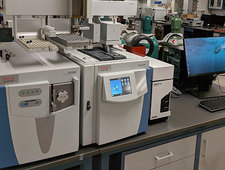
The Materials Characterization Facility (MCF) provides world-class equipment and instrumentation to support scientific advancements and the characterization and synthesis of any new materials. The following characterization capabilities are available: surface, crystallographic, spectroscopic, thermal, electrochemical, trace molecule detection, rheometric, dynamic mechanical testing, and tribology.
Explore the Materials Characterization Facility
Notre Dame Integrated Imaging Facility
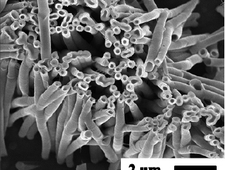
The Notre Dame Integrated Imaging Facility provides an integrated suite of sophisticated microscopes and imaging stations, enabling expert users to attack complex modern research problems and, equally important, resident professional staff to guide the non-expert users. The facility has instrumentation and expertise in electron microscopy, including scanning electron and transmission electron microscopes, and optical microscopy to support materials development through characterization.
Explore the Integrated Imaging Facility
Notre Dame Nanofabrication Facility
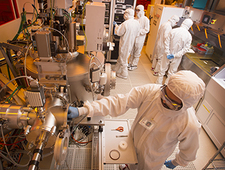
Located in the Stinson-Remick Hall of Engineering, the Notre Dame Nanofabrication Facility is a 9,000 sq. ft. clean room containing processing tools for fabrication of nano and microelectronic devices, integrated circuits, optoelectronic and nanomagnetic devices, microfluidic devices and sensors, and a wide variety of nanostructures and engineered surfaces for research.
Explore the Nanofabrication Facility
Magnetic Resonance Research Center
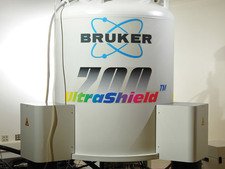
The Magnetic Resonance Research Center supports Notre Dame research in chemistry, biochemistry, molecular biology, and related fields. The Center operates eight different nuclear magnetic resonance spectrometers for liquids analysis ranging in magnetic field strength from 7 to 18.8 Tesla.
Explore the Magnetic Resonance Research Center
Center for Environmental Science & Technology
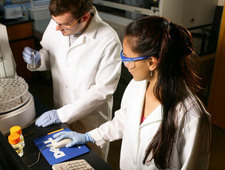
The Center for Environmental Science and Technology (CEST) is a shared asset facility. While the Center's primary focus is on providing instrumentation for graduate students to complete the research necessary in attaining their degrees, CEST is accessible to all Notre Dame community members, their collaborators, and visiting researchers. CEST provides capabilities in chromatography, carbon analysis, elemental analysis, particle characterization, and stable isotope analysis.
Explore the Center for Environmental Science & Technology
Engineering & Design Core Facility
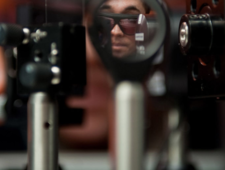
The Engineering & Design Core Facility (EDCF) is a centralized group of highly skilled, on-campus engineers who work closely with faculty and staff on research across a wide range of disciplines. The EDCF offers expertise in the development of custom hardware and equipment. From consultation to detailed design work to rapid prototyping and testing, EDCF employees facilitate the process of going from concept to construction for researchers wanting to develop cutting-edge technologies.
Explore the Engineering and Design Core Facility
Center for Research Computing
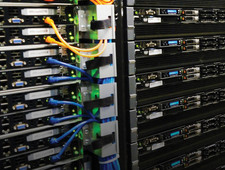
The CRC houses three complementary resources: the High Performance Computing section, providing over 25,000 cores of computational power with the associated support infrastructure for both hardware and installed software; the Cyberinfrastructure section, empowering faculty and industry partners to develop research environments that support advanced data and information processing services; and the Research Development group, cultivating better, more sustainable software to enable world-class research.